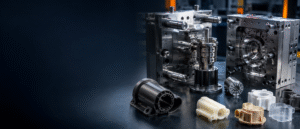
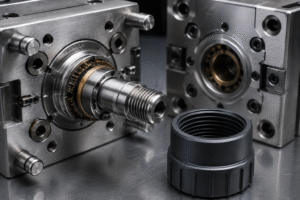
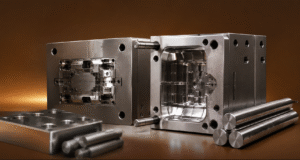
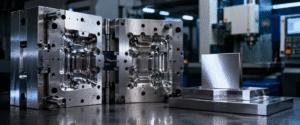
Manufyn evaluates shrinkage to protect part dimensions.
Injection molding shrinkage is one of the most critical yet misunderstood factors in plastic part manufacturing. If shrinkage is not correctly accounted for during design and tooling, it can lead to dimensional inaccuracies, assembly failures, warpage, cosmetic defects, and costly mold rework.
Understanding the shrinkage rate in injection molding helps manufacturers predict final part dimensions, design better molds, and maintain consistent quality—especially in high-volume production. This resource explains what shrinkage is, why it occurs, and how it impacts real-world manufacturing outcomes.

What is Shrinkage in Injection Molding?
Shrinkage in injection molding refers to the dimensional reduction that occurs when molten plastic cools and solidifies inside the mold cavity and after ejection. In simple terms, the plastic part becomes smaller than the mold cavity it was formed in.
When plastic is injected into the mold, it is in a molten state at high temperature. As it cools, the polymer chains contract, causing the material to shrink. This shrinkage continues even after the part is ejected from the mold, which is why mold cavities are intentionally designed larger than the final required part dimensions.
In practical manufacturing terms, shrinkage is the difference between:
- The mold cavity dimension, and
- The final cooled part dimension
This phenomenon is commonly referred to as part shrinkage in injection molding, and it varies depending on material type, processing conditions, and mold design.
Why this matters
If shrinkage is not accurately calculated and compensated for, parts may fail to meet tolerance requirements, resulting in poor fit, rejected batches, or retooling.
Not sure how shrinkage will affect your part?
Share your drawing and material choice to get a shrinkage feasibility assessment from our tooling engineers.
Why Shrinkage Occurs in Injection Molding
Shrinkage in injection molding occurs primarily due to material behavior during cooling and solidification, but it is strongly influenced by tooling and processing decisions. Understanding why shrinkage happens is essential before learning how to calculate shrinkage in injection molding or how to control it.
When molten plastic is injected into a mold cavity, it occupies more volume than it will in its solid state. As the material cools, polymer chains move closer together, resulting in volumetric contraction. This contraction leads to part shrinkage once the material solidifies and continues to cool after ejection.
Key reasons why injection molding shrinkage occurs include:
- Thermal contraction of plastic material, as all polymers shrink when transitioning from molten to solid state
- Material crystallization, especially in semi-crystalline plastics like PP, PE, and Nylon, which shrink more than amorphous plastics
- Insufficient packing pressure or holding time, which prevents compensation for material contraction
- Uneven cooling, often caused by inconsistent wall thickness or inefficient cooling channel design
- Molecular orientation, where flow direction influences how much the part shrinks in different axes
In real-world manufacturing, shrinkage is rarely uniform. This is why part shrinkage in injection molding can cause dimensional mismatch, warpage, or assembly issues if not addressed during mold design.
-
Engineering insight:
Most shrinkage-related failures are not material problems—they are tooling and process problems.
Injection Molding Shrinkage Rates by Material
Different plastics shrink at different rates, which is why material selection plays a critical role in injection molding shrinkage calculation. Even small changes in resin type can significantly impact final part dimensions.
Below is a typical shrinkage rate range for commonly used injection molding materials. Actual values may vary based on processing conditions, mold design, and filler content.
Typical Injection Molding Shrinkage Rates
| Material | Typical Shrinkage Rate |
|---|---|
| ABS | 0.4% – 0.7% |
| Polycarbonate (PC) | 0.5% – 0.7% |
| Nylon (PA 6 / PA 66) | 1.0% – 2.0% |
| Polypropylene (PP) | 1.5% – 2.5% |
| High Density Polyethylene (HDPE) | 1.5% – 3.0% |
| Acetal (POM) | 1.5% – 2.1% |
| Glass-Filled Plastics | 0.2% – 0.8% |
Important Material Insights
- Amorphous plastics (ABS, PC) generally exhibit lower and more predictable shrinkage
- Semi-crystalline plastics (PP, PE, Nylon) show higher and more variable shrinkage
- Glass-filled materials reduce shrinkage but introduce directional variation
- Fiber orientation can cause different shrinkage rates along and across flow direction
Because of these variations, injection molding shrinkage calculation should never rely on generic values alone. Mold cavity dimensions must be customized based on the exact resin grade and part geometry.
-
Choosing between materials?
The wrong plastic choice can double your shrinkage risk.

How to Calculate Shrinkage in Injection Molding
Understanding how to calculate shrinkage in injection molding is essential for predicting final part dimensions and designing accurate mold cavities. Shrinkage calculation allows tooling engineers to intentionally oversize the mold so that the cooled part meets the required dimensions.
In simple terms, injection molding shrinkage calculation compares the mold cavity dimension to the final molded part dimension after cooling.
Injection Molding Shrinkage Formula
Shrinkage (%) = Mold Dimension − Final Part Dimension / Mold Dimension × 100
What Each Term Means
- Mold Dimension: The size of the cavity machined into the mold
- Final Part Dimension: The measured dimension of the cooled, stabilized molded part
- Shrinkage (%): The percentage reduction due to material contraction
This formula is the foundation of injection molding shrinkage calculation, but it must always be applied with material behavior and process conditions in mind.
Example: Shrinkage Calculation in Injection Molding
Assume a mold cavity is designed to be 100 mm, and the final molded part measures 98.8 mm after cooling.
Shrinkage (%)=100−98.8 / 100 × 100 = 1.2%
This means the part shrinkage in injection molding for this feature is 1.2%.
In practice, engineers apply this shrinkage value in reverse while designing the cavity, ensuring that after cooling, the part achieves the target dimension.
Important note:
Shrinkage is often directional, meaning the shrinkage rate along the flow direction may differ from the transverse direction. This is especially common in fiber-filled or semi-crystalline materials.
Designing a mold or validating a tool?
We can verify shrinkage assumptions before steel is cut. Request Injection Molding Shrinkage Calculation Support
Factors That Influence Shrinkage Rate in Manufacturing
The shrinkage rate in manufacturing, particularly in injection molding, is influenced by a combination of material properties, tooling design, and process parameters. Ignoring any one of these factors can lead to dimensional variation, warpage, or poor assembly fit.
Key Factors Affecting Injection Molding Shrinkage
- Plastic material type, as amorphous and semi-crystalline polymers shrink differently
- Melt temperature, where higher temperatures generally increase shrinkage
- Mold temperature, which affects cooling rate and crystallization behavior
- Packing pressure and holding time, which compensate for material contraction
- Wall thickness variation, as thicker sections shrink more than thin sections
- Gate location and size, which influence material flow and pressure distribution
- Cooling system efficiency, which impacts uniformity of shrinkage across the part
Because these variables interact, part shrinkage in injection molding cannot be controlled by material selection alone. It must be managed holistically through design and processing decisions.
-
Manufacturing insight:
Most dimensional issues blamed on shrinkage are actually caused by uneven cooling or insufficient packing.
Common Shrinkage Problems in Injection Molded Parts
When injection molding shrinkage is not properly accounted for during design or tooling, it often leads to repeatable and costly part defects. These issues typically surface during trial runs, assembly, or after parts have been in use for some time.
One of the most common problems caused by part shrinkage in injection molding is dimensional mismatch. Parts may appear correct immediately after molding but drift out of tolerance after cooling or during storage, leading to poor fit or failed assemblies.
Other shrinkage-related issues include:
- Warpage, where uneven shrinkage causes the part to bend or twist, especially in large flat components.
- Sink marks, which occur when thicker sections shrink more internally than on the surface.
- Assembly misalignment, caused by inconsistent shrinkage across mating features.
- Tolerance stack-up issues, where multiple small dimensional changes accumulate into functional failure.
- Cosmetic defects, particularly in visible consumer or enclosure parts where surface uniformity is critical.
In many cases, these problems are mistakenly addressed through process tweaks alone. However, true shrinkage issues usually require tooling-level or design-level corrections rather than short-term processing adjustments.
-
Design clarification:
Shrinkage-related defects often indicate that cavity sizing, cooling balance, or gate strategy was not optimized early enough.
How to Control & Reduce Shrinkage in Injection Molding
While shrinkage cannot be completely eliminated, it can be controlled and predicted through the right combination of material selection, tooling design, and process optimization. Managing shrinkage early in the project lifecycle significantly reduces downstream rework and tooling corrections.
Effective ways to control injection molding shrinkage include:
- Designing mold cavities with accurate shrinkage allowance, based on material data and part geometry rather than generic values.
- Optimizing gate location and size, ensuring uniform pressure distribution during packing.
- Using proper packing pressure and holding time, allowing molten material to compensate for volumetric contraction.
- Balancing wall thickness, which minimizes differential cooling and uneven shrinkage.
- Designing efficient cooling channels, ensuring uniform heat extraction across the mold.
- Selecting filled or reinforced materials, where appropriate, to reduce overall shrinkage and improve dimensional stability.
In high-precision or high-volume applications, shrinkage control is most effective when addressed during DFM and tooling design, rather than during production trials.
-
Engineering insight:
Most successful shrinkage control strategies are implemented before the mold is built, not after parts fail inspection.
Looking for guidance on shrinkage control for your part?
We can review designs and tooling strategies to help avoid avoidable corrections.
Shrinkage vs Warpage – What’s the Difference?

Shrinkage and warpage are often discussed together in injection molding, but they are not the same phenomenon. Understanding the difference is critical when diagnosing dimensional issues and deciding whether the solution lies in material selection, tooling design, or process adjustment.
Injection molding shrinkage refers to the natural reduction in size that occurs as molten plastic cools and solidifies. Shrinkage is expected, predictable to an extent, and typically compensated for by oversizing the mold cavity.
Warpage, on the other hand, occurs when shrinkage is uneven across the part. Instead of shrinking uniformly, different areas of the part cool and contract at different rates, causing bending, twisting, or distortion.
Key Differences Between Shrinkage and Warpage
| Aspect | Shrinkage | Warpage |
|---|---|---|
| Nature | Uniform dimensional reduction | Uneven dimensional change |
| Cause | Material cooling and contraction | Differential cooling or shrinkage |
| Predictability | Largely predictable | Often geometry and process dependent |
| Typical Fix | Cavity size compensation | Cooling, gating, or design changes |
| Impact | Size mismatch | Shape distortion |
In practice, part shrinkage in injection molding often becomes the root cause of warpage when cooling is not uniform or when wall thickness varies significantly. Treating warpage without addressing the underlying shrinkage imbalance usually leads to repeated trial-and-error adjustments.
-
Practical takeaway
Shrinkage is unavoidable, but warpage is often preventable with better design and tooling decisions.
Shrinkage Considerations During Tooling Design
Shrinkage must be addressed deliberately during tooling design, as mold geometry directly determines whether the final part will meet dimensional requirements after cooling. Once a mold is built, correcting shrinkage-related issues becomes expensive and time-consuming.
During mold design, engineers typically account for injection molding shrinkage by applying calculated oversizing to the cavity dimensions. However, this approach alone is not sufficient for complex parts or tight tolerances.
Key tooling-level considerations for managing shrinkage rate in manufacturing include:
- Cavity oversizing based on actual material data, not generic shrinkage ranges.
- Directional shrinkage compensation, especially for fiber-filled or semi-crystalline materials.
- Balanced gate placement, ensuring even packing pressure across all features.
- Cooling channel layout optimization, reducing temperature gradients within the mold.
- Multi-cavity consistency, where shrinkage variation between cavities must be minimized.
- Tolerance stacking analysis, particularly for assemblies with multiple mating parts.
In high-volume production, even minor shrinkage variation can result in large numbers of rejected parts. This is why shrinkage planning is a core part of tooling design rather than a secondary consideration.
-
Manufacturing insight
The most effective shrinkage corrections are made on paper and in simulation, not on the shop floor.
When Should You Worry About Shrinkage in Injection Molding?
Not every molded part requires extreme shrinkage control. However, there are specific situations where injection molding shrinkage becomes a critical design and manufacturing risk rather than a manageable variable.
You should pay close attention to part shrinkage in injection molding when:
- The part has tight dimensional tolerances or must mate with other precision components.
- The design includes large flat surfaces, where uneven shrinkage can easily cause warpage.
- Multiple parts must interlock or assemble together, such as housings, clips, or snap-fit features.
- The application involves high-volume production, where small dimensional variation can lead to large-scale rejection.
- Different materials or fillers are being evaluated, which may significantly change shrinkage behavior.
- The product will operate under thermal or mechanical stress, where post-mold dimensional stability matters.
In these scenarios, shrinkage should not be treated as a secondary effect. Instead, it should be evaluated early through design reviews, material selection, and tooling strategy discussions.
-
Engineering perspective:
Shrinkage problems discovered during production are usually symptoms of decisions made much earlier in the design or tooling phase.
Working on a part with tight fit or high volume requirements?
Early clarity can help avoid later corrections.
How Manufyn Helps Control Injection Molding Shrinkage
Managing injection molding shrinkage requires more than applying a standard percentage. It demands an understanding of material behavior, tooling design, and process interaction. At Manufyn, shrinkage control is addressed as part of an integrated engineering workflow rather than a post-production fix.
Manufyn supports shrinkage management through:
- Design for Manufacturability (DFM) reviews, focusing on wall thickness balance, gating strategy, and tolerance allocation.
- Material-specific shrinkage evaluation, ensuring cavity sizing is based on real resin behavior rather than generic data.
- Tooling design inputs, including directional shrinkage compensation and cavity balance for multi-cavity molds.
- Process validation during trials, where shrinkage behavior is verified before production scale-up.
- Iteration support, allowing controlled adjustments when required without unnecessary tooling rework.
This approach helps manufacturers achieve predictable dimensions, stable assemblies, and consistent quality across production runs.
- How this helps
Most shrinkage-related risks can be mitigated before steel is cut, when decisions are still flexible.
Conclusion
Shrinkage is an inherent part of injection molding, but its impact on quality, fit, and performance depends entirely on how well it is understood and managed. By knowing what is shrinkage in injection molding, learning how to calculate shrinkage in injection molding, and accounting for material and tooling factors early, manufacturers can avoid many common dimensional and assembly issues.
Effective shrinkage management is not about eliminating shrinkage, but about predicting it accurately and designing for it intelligently. When addressed early through design, material selection, and tooling strategy, shrinkage becomes a controlled variable rather than a production risk.
Frequently Asked Questions (FAQs)
What is shrinkage in injection molding?
Shrinkage in injection molding refers to the dimensional reduction that occurs as molten plastic cools and solidifies, resulting in a final part that is smaller than the mold cavity.
How much shrinkage is normal in injection molding?
Typical injection molding shrinkage ranges from 0.2% to 3%, depending on the material type, filler content, and processing conditions.
How do you calculate injection molding shrinkage?
Injection molding shrinkage calculation is done using the formula:
(Mold dimension − Final part dimension) ÷ Mold dimension × 100.
Does glass-filled plastic reduce shrinkage?
Yes, glass-filled plastics generally shrink less than unfilled materials, but they can introduce directional shrinkage that must be considered during tooling design.
Can shrinkage be eliminated completely?
Shrinkage cannot be eliminated, but it can be predicted and controlled through proper design, tooling, and process optimization.