How Manufyn transformed an early-stage aeroponic concept into a scalable, manufacturable vertical farming system
Client Overview
A domestic agri-tech startup was developing an innovative aeroponic tower aimed at enabling high-yield, water-efficient vertical farming. The concept focused on controlled nutrient delivery, compact footprint, and ease of assembly, making it suitable for urban and commercial farming environments.
The startup required a single development partner who could convert this concept into a fully engineered, manufacturable product, ready for pilot deployment and eventual scale-up. The objective was not only to build a working prototype, but to ensure that the system was reliable, easy to assemble, and aligned with mass production requirements.
Project Scope
Manufyn was engaged as an end-to-end development partner and was responsible for the complete product lifecycle. This included:
- Product engineering and design support
- Material selection for both structural and functional components
- Prototype development and functional validation
- Manufacturing process selection and vendor coordination
- Final assembly and system-level testing
This single-partner execution model reduced coordination complexity and accelerated decision-making throughout the project.
Engineering and Product Development Approach
Design for Aeroponics and Manufacturability
Manufyn worked closely with the startup to understand the functional principles of aeroponic farming, including plant spacing requirements, nutrient misting behavior, water circulation paths, and structural load conditions. Based on this understanding, engineering inputs were provided to optimize:
- Tower geometry to ensure uniform nutrient and mist distribution across plant zones
- Structural strength while maintaining a lightweight and stable form factor
- Modular construction to simplify transport, installation, and future expansion
- Design features aligned with mass production and repeatable manufacturing
This ensured that performance and manufacturability were addressed simultaneously, rather than sequentially.
Material Selection
Material selection was carried out with a strong focus on outdoor exposure, moisture resistance, and long-term durability. Suitable polymer and structural materials were finalized based on:
- UV resistance for outdoor and semi-outdoor environments
- Chemical compatibility with nutrient solutions
- Resistance to moisture, corrosion, and continuous operation
- Long-term durability under repeated use and cleaning cycles
This approach ensured that material choices supported both functional performance and product lifespan.
Rapid Prototyping and Validation
A rapid prototyping approach was adopted to validate the concept quickly and iteratively.
- Prototype components were developed to assess fit, assembly sequence, and ergonomics.
- Multiple iterations were executed to improve airflow, mist coverage, and ease of maintenance.
- Feedback from trial runs and hands-on evaluation was incorporated into successive design refinements.
This allowed the startup to validate real-world performance before committing to production tooling.
Manufacturing Process Development
Manufyn identified and developed the most suitable manufacturing processes for each component in the system.
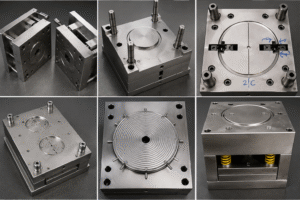
- Injection molding was selected for repeatable plastic components requiring consistency and scalability.
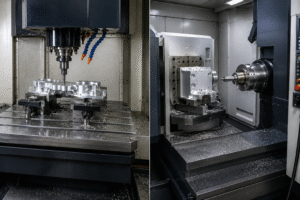
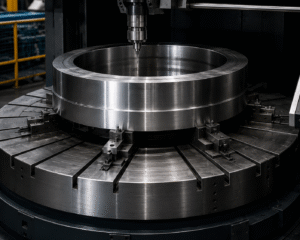
- Machining and fabrication were used for structural and functional elements where precision and strength were critical.
- Secondary operations and finishing processes were defined to ensure durability, weather resistance, and visual quality.
The design was aligned with these processes from the beginning, minimizing rework during scale-up.
Assembly and System Integration
The complete aeroponic tower was assembled and tested as an integrated system rather than as individual parts. Manufyn ensured:
- Proper alignment and fitment of all modular components
- Leak-free water circulation throughout the system
- Uniform misting and nutrient delivery across plant zones
- Ease of disassembly for cleaning, maintenance, and servicing
System-level integration testing ensured that the product functioned reliably as a complete solution.
Quality Control and Testing
Functional testing was carried out to validate:
- Structural stability of the tower under operational conditions
- Performance and consistency of the nutrient delivery system
- Reliability during continuous operation cycles
- Consistency across multiple assembled units
This testing phase ensured confidence in both product performance and repeatability.
Project Outcome
The project delivered clear outcomes aligned with the startup’s goals:
- A fully functional aeroponic tower was developed from concept to working product.
- The design was validated for performance, usability, and manufacturability.
- The system was confirmed to be ready for pilot deployment and future scale-up.
- Development time was significantly reduced through single-partner execution.
Value Delivered by Manufyn
- End-to-end product development support under one roof
- Faster time to market for an early-stage agri-tech startup
- Cost-optimized design aligned with mass production requirements
- Reduced technical and manufacturing risk through early validation
Manufyn’s Value Proposition
This case study highlights Manufyn’s capability to develop complex, system-level products for emerging startups.
- Manufyn combined engineering, manufacturing, and rapid prototyping expertise to deliver a complete solution.
- Early alignment between design and manufacturing ensured smooth scalability.
- Integrated execution reduced coordination challenges and accelerated progress.
- The startup gained a production-ready system with confidence to scale.
Developing a system-level product and need end-to-end execution support?
Share your concept to explore how it can be engineered, validated, and scaled efficiently.