Technical Brief: Rapid Prototyping of a 3-Plate Injection Mold for High-Precision Components
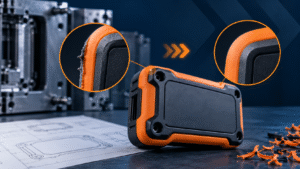
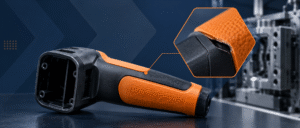
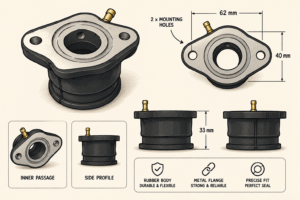
Manufyn delivered a rapid prototyping solution for a high-precision plastic component with complex geometry and strict cosmetic requirements. To meet the client’s need for faster sampling and design flexibility prior to mass production, a 3-plate injection mold was selected and engineered.
Key Technical Highlights:
Tooling Strategy: A 3-plate mold architecture enabled pinpoint and centrally located gating, ensuring balanced melt flow, uniform packing, and elimination of visible gate marks. Automatic runner separation reduced cycle time and removed the need for manual degating.
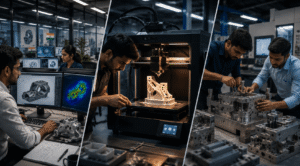
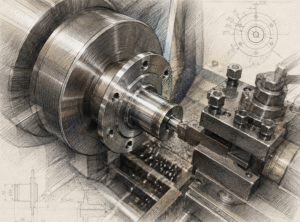
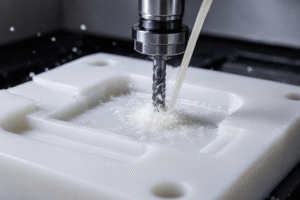
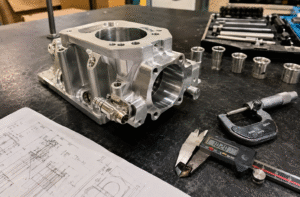
Rapid Prototyping Approach: Standardized mold bases and insert-based cavity/core designs allowed quick design iterations. CNC machining, EDM, and wire-cut processes ensured dimensional accuracy, while controlled polishing achieved production-grade surface finishes.
Outcome: The solution delivered cosmetically superior, dimensionally accurate samples within compressed timelines and provided a scalable tooling foundation for future mass production.
How Manufyn enabled faster sampling, superior aesthetics, and design flexibility before mass production
Project Overview
A global client approached Manufyn to develop a plastic injection molded component featuring complex geometry, multiple gating requirements, and strict aesthetic standards. The component demanded precise flow control, uniform surface finish, and flexibility for future design changes, as the product was still in its development and validation phase.
The client required rapid prototyping, faster sampling cycles, and the ability to accommodate design iterations before committing to mass production tooling. After conducting a detailed design and manufacturability review, Manufyn proposed a 3-plate injection molding tool, developed using a rapid prototyping approach. This strategy ensured shorter lead times while maintaining production-level quality standards.
Understanding Injection Mold Types
2-Plate Injection Mold Mechanism
A 2-plate injection mold is the most commonly used mold design in plastic injection molding and is generally preferred for simpler components.
Key characteristics of a 2-plate mold include:
- The mold consists of two primary plates: the cavity plate and the core plate.
- The parting line is single and relatively simple.
- The runner system and molded part are ejected together during mold opening.
- Gates are typically located on the parting line, often as edge or direct gates.
Working mechanism:
When the mold opens, the molded part and the runner system are ejected simultaneously. Because the gate is located on the parting line, visible gate marks may remain on the finished component.
Typical applications:
2-plate molds are commonly used for parts with simple geometry, high-volume production requirements, and where lower tooling cost is a primary consideration.
3-Plate Injection Mold Mechanism
A 3-plate injection mold consists of three primary plates:
- The cavity plate
- The core plate
- The runner or stripper plate
Working mechanism:
When the mold opens, the first separation occurs between the runner plate and the cavity plate, allowing the runner system to detach automatically. A second separation then releases the molded part from the core side. This dual-opening action enables automatic runner separation and allows gates to be placed at optimal locations on the part.
This design makes it possible to use pinpoint or centrally located gates without compromising part aesthetics.
Why Manufyn Selected a 3-Plate Injection Mold
Based on the component’s design and performance requirements, Manufyn recommended a 3-plate injection mold due to several technical and functional advantages.
- The part required multiple gate locations to ensure balanced and uniform filling.
- Central or pinpoint gating was necessary to achieve superior surface finish and avoid visible gate marks
- Thin wall sections demanded consistent melt flow and controlled packing.
- Manual degating needed to be eliminated to support rapid prototyping cycles.
- The geometry involved strict cosmetic standards that could not be met with edge gating.
The 3-plate mold design ensured consistent part quality while supporting rapid design iterations during the prototyping and validation stage.
Rapid Prototyping Approach by Manufyn
To reduce development time and tooling cost, Manufyn implemented a rapid prototyping injection molding strategy tailored to early-stage product development.
This approach included:
- Standardized mold base selection to reduce lead time.
- Insert-based cavity and core design to enable quick design modifications.
- CNC machining for fast and efficient material removal.
- EDM and wire-cut operations to create high-precision features.
- Controlled polishing processes to achieve the required cosmetic surface finish.
By combining these techniques, Manufyn enabled faster tool modification cycles, reduced rework costs, and accelerated sample approvals without sacrificing dimensional accuracy or aesthetics.
Importance of 3-Plate Injection Molds in Product Development
3-plate injection molds play a critical role in modern plastic product development, especially during prototyping and pre-production stages.
Their importance lies in the fact that they:
- Enable pinpoint gating without compromising part appearance.
- Support multi-cavity designs with balanced melt flow.
- Improve surface finish by hiding gate marks in non-visible areas.
- Reduce post-molding operations such as trimming or manual degating.
- Provide greater flexibility for future design changes.
For clients validating product performance, appearance, and functionality, 3-plate molds offer a significant advantage over conventional tooling approaches.
Project Outcome
The project delivered measurable results aligned with the client’s development objectives.
- A high-precision 3-plate injection mold was developed within compressed timelines.
- Prototype samples met both dimensional accuracy and cosmetic requirements.
- Iteration time during product validation was significantly reduced.
- The mold design was scalable and suitable for future mass production.
Manufyn’s Value Proposition
This project highlights Manufyn’s capability to combine advanced injection mold design with rapid prototyping methodologies.
- Manufyn demonstrated strong expertise in 3-plate injection mold design for complex, high-aesthetic components.
- The team enabled rapid sampling and design flexibility without compromising production-level quality.
- Insert-based tooling and standardized mold strategies reduced development risk and cost.
- End-to-end ownership ensured a smooth transition from prototyping to scalable manufacturing.
Evaluating complex gating or prototyping strategies for a new plastic component?
Share your drawing to explore the right tooling approach before committing to production.